|
Getting your Trinity Audio player ready...
|
Table of Contents
ToggleWhy Virtual Office GST Registration Gets Rejected? REG-03 Notice Explained
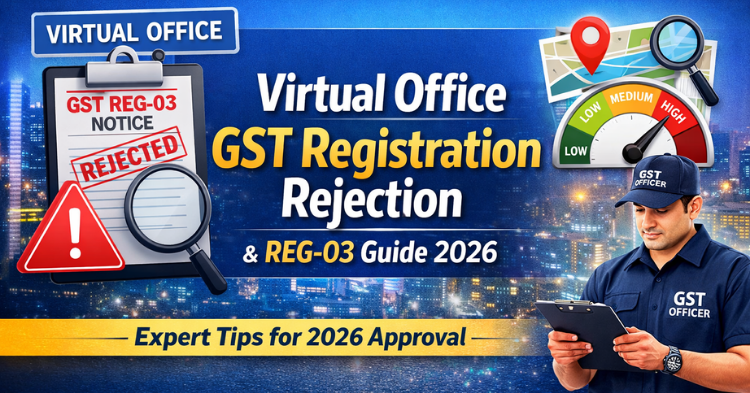
In 2026, getting GST on a virtual office is no longer just about uploading documents. The GST system now works on a “verification-first” model. Every application is scored by the portal before it even reaches an officer. If your profile looks risky, the system automatically triggers a REG-03 notice or a mandatory physical visit.
At CharteredHelp, we handle GST cases daily for startups, freelancers, and e-commerce sellers in Noida and across India. Most cases of Virtual Office GST Registration Rejection happen not because virtual offices are illegal—but because applicants don’t understand how the system thinks.
This guide explains the real logic behind rejections, so you can pass both the portal’s algorithm and the officer’s verification.
What Is Virtual Office GST Registration?
A virtual office is a legally usable business address that lets you:
Register your company
Use it as your Principal Place of Business (PPOB)
Receive mail and notices
Show a professional presence in cities like Noida, Delhi, or Bangalore
It is commonly used by:
Freelancers
E-commerce sellers
Startups & consultants
Remote teams
New entrepreneurs
GST law allows using a virtual office—but only if the place is real, verifiable, and legally compliant.
The “Verification First” Era (2026 Rules)
Earlier, GST registration was document-driven. Now, it is risk-driven.
Rule 21 & 25 empower officers to cancel or verify if the business appears “non-existent”.
GSTN advisories now require biometric authentication, geotagged photos, and map location.
The portal uses AI/ML via its BIFA module (Business Intelligence & Fraud Analytics) to assign a Risk Score to every application.
A virtual office is no longer a grey area. It is a separate category with its own automated triggers.
Why Virtual Office GST Registration Gets Rejected in India?
Most rejections happen because GST officers want to ensure that:
“A real business exists at this address.”
With fake addresses and shell firms increasing, the department now focuses on:
Physical verification
Address accuracy
Owner consent
Commercial zoning
On-ground existence
When something looks doubtful, the officer issues a REG-03 notice.
What is REG-03 Notice in GST?
REG-03 is a Clarification Notice sent by the GST Department when:
Documents look doubtful
Address does not match
Verification fails
Virtual office seems non-existent
It usually asks for:
Additional documents
Explanation of address
Proof of business existence
You get 7 working days to reply.
If the reply is weak or delayed → Application is rejected (REG-05).
Top Reasons for Virtual Office GST Registration Rejection
1. Address Mismatch
Even a small difference can trigger rejection.
Example:
Agreement: Office No. 502, 5th Floor, ABC Tower
GST Form: 502, ABC Tower
This looks minor—but for GST, it is a red flag.
2. Invalid or Generic NOC
Many providers give:
Template NOC
No owner signature
No property details
Officers cross-check authenticity. Fake or weak NOC = REG-03.
3. Non-Commercial Property
If your virtual office is in:
Residential flat
Society without commercial approval
GST may reject saying: “Place not suitable for business.”
4. Officer Could Not Verify Business
In many cases:
Officer visits
No staff is present
No one knows your firm
No board is displayed
Result: “Non-existent business” remark.
5. Too Many Firms at One Desk
When 30–40 companies show:
Same cabin
Same photo
Same layout
It creates suspicion of a “paper office”.
Real Client Scenarios from CharteredHelp
Case 1 – Amazon Seller (Noida):
A seller applied using a cheap virtual office. Officer visited.
Guard said: “Yahan koi company nahi chalti.”
REG-03 issued. Application rejected.
We re-filed using a verified GST-ready office with signage and staff.
Result: GST approved in 6 days.
Case 2 – Freelancer from Delhi:
He uploaded:
Old electricity bill (4 months old)
NOC without owner ID
REG-03 came asking for “Proof of Right to Use Premises”.
He ignored the notice—application closed.
We handled fresh registration with proper documents and guided REG-03 response.
GST approved smoothly.
These are not rare cases. We handle such issues daily.
Common Mistakes People Make with Virtual Office GST
Using the cheapest provider without verification support
Uploading expired utility bills
Editing address manually
Using fake or unsigned NOC
Not replying REG-03 properly
Assuming “virtual office is enough”
Virtual office is valid—but only when done correctly.
How to Avoid REG-03 & GST Rejection
From our 10+ years of experience at CharteredHelp, follow this checklist:
Choose a GST-ready virtual office provider
Ensure property is commercially approved
Keep address word-to-word same everywhere
Use latest utility bill (within 60 days)
Take owner-signed NOC with ID proof
Ask provider about physical verification support
Display:
Business name
“GST Applied” board
Be ready for biometric & geo-tag verification
Reply REG-03 within 7 days with clear proof
Consult a GST expert before submission
At CharteredHelp, we prepare REG-03 replies like a case file, not a casual upload.
Latest GST Verification Trend (2026 Update)
| Old Process (Before) | New Process (2026) |
|---|---|
| Document-based | Physical + Digital |
| Rare visits | Surprise visits |
| No biometrics | Aadhaar & biometric |
| Easy approvals | Risk-based scrutiny |
| Minimal checks | Geo-tag + AI review |
This is why Virtual Office GST Registration Rejection cases have increased.
Is Virtual Office Still Safe for GST in 2026?
Yes—if done correctly.
Virtual office is legal.
But casual registration is no longer accepted.
It is safe when:
Address is genuine
Provider supports verification
Documents are accurate
Expert handles application
Why Choose CharteredHelp for GST Registration in Noida?
At CharteredHelp, we don’t just “apply GST”.
We:
Audit your virtual office before use
Match every document
Prepare REG-03 replies
Coordinate with providers
Handle physical verification issues
Ensure zero-risk submission
We are based in Noida and handle GST cases across India.
Conclusion
Most cases of Virtual Office GST Registration Rejection happen not because the idea is wrong—but because the execution is careless.
A virtual office is not just an address.
It is your legal identity in GST records.
If your application is:
Rejected
Stuck
You received REG-03
Planning GST on virtual office
📞 Call CharteredHelp now: +91-9266685656
📍 Noida | PAN India Support
We help you get GST approved right the first time—without stress, without rejection.
FAQ's for Virtual Office GST Registration Rejection
Virtual Office GST Registration gets rejected mainly due to address mismatch, weak NOC, residential zoning, failed physical verification, or when too many GSTINs are registered at the same location. In 2026, the GST portal also assigns a risk score, and high-risk profiles trigger REG-03 automatically.
REG-03 is a clarification notice issued by the GST department when your virtual office address or documents look doubtful. It asks for additional proof like NOC, utility bill, photos, or explanation of business existence. You must reply within 7 working days.
Yes. A virtual office is legal as a Principal Place of Business (PPOB) under the CGST Act, provided you have the right to use the premises and the address is genuine and commercial.
You need:
Rent/Service Agreement
Owner’s NOC
Latest utility bill (within 60 days)
PAN & Aadhaar of promoters
Incorporation certificate
DSC (if applicable)
For better approval chances, add property tax receipt or landline bill.
To avoid rejection:
Use a GST-ready virtual office
Keep address word-to-word same everywhere
Use fresh utility bills
Ensure owner-signed NOC
Display business signage
Be ready for physical verification
Reply REG-03 professionally
If you fail to reply within 7 working days, your GST application will be rejected under REG-05, and you will need to file a fresh application.
Yes, virtual office is safe for Amazon and Flipkart sellers if GST is approved properly. Many rejections happen because sellers choose cheap providers without verification support.
Yes. In 2026, GST officers can conduct surprise physical visits to verify whether the business exists at the declared address.
There is no fixed legal limit, but when too many GSTINs are registered on the same desk or office number, the portal flags it as high-risk, increasing chances of REG-03 or rejection.
Yes. You can choose a better GST-ready virtual office and apply again with correct documents and verification support.
Yes, a virtual office is legal for GST registration if it is a commercial address and you have proper documents like NOC and address proof. The GST law allows any place of business, including shared and virtual offices, as long as it is genuine and verifiable.
You don’t always need a rent agreement. For most virtual offices, an Owner NOC (No Objection Certificate) along with electricity bill or property proof is enough. The key is that the documents must match your GST application word-to-word.
Normally, GST registration takes 7–10 working days. With new checks in 2026 (biometric, physical visit, geo-tagging), it may take 10–15 days if verification is done smoothly.
Yes, startups, freelancers, consultants, and online sellers can use a virtual office. It helps you get a professional business address without paying high rent and is perfect for early-stage businesses.
Charteredhelp receives your GST and government letters at the virtual office address and:
Notifies you instantly
Scans and shares copies
Forwards physical mail (if required)
So you never miss any important notice.
Yes. Once your GST is approved, you can legally use your virtual office address on:
Website
Invoices
Letterheads
Business profiles
It looks professional and builds trust with clients.
If your plan expires:
Mail handling may stop
GST department may mark your address as inactive
You may receive a notice for non-availability
So, always renew on time to keep your GST active and avoid compliance issues.

CharteredHelp is a team of experienced professionals providing tax, accounting, auditing, and compliance services for businesses and individuals. With over 10+ years of experience, we assist clients with GST registration and filings, income tax returns, company registration, trademark services, accounting, auditing, and handling tax notices. Our focus is on providing practical, reliable, and timely support to help clients stay compliant and grow their businesses with confidence.