Table of Contents
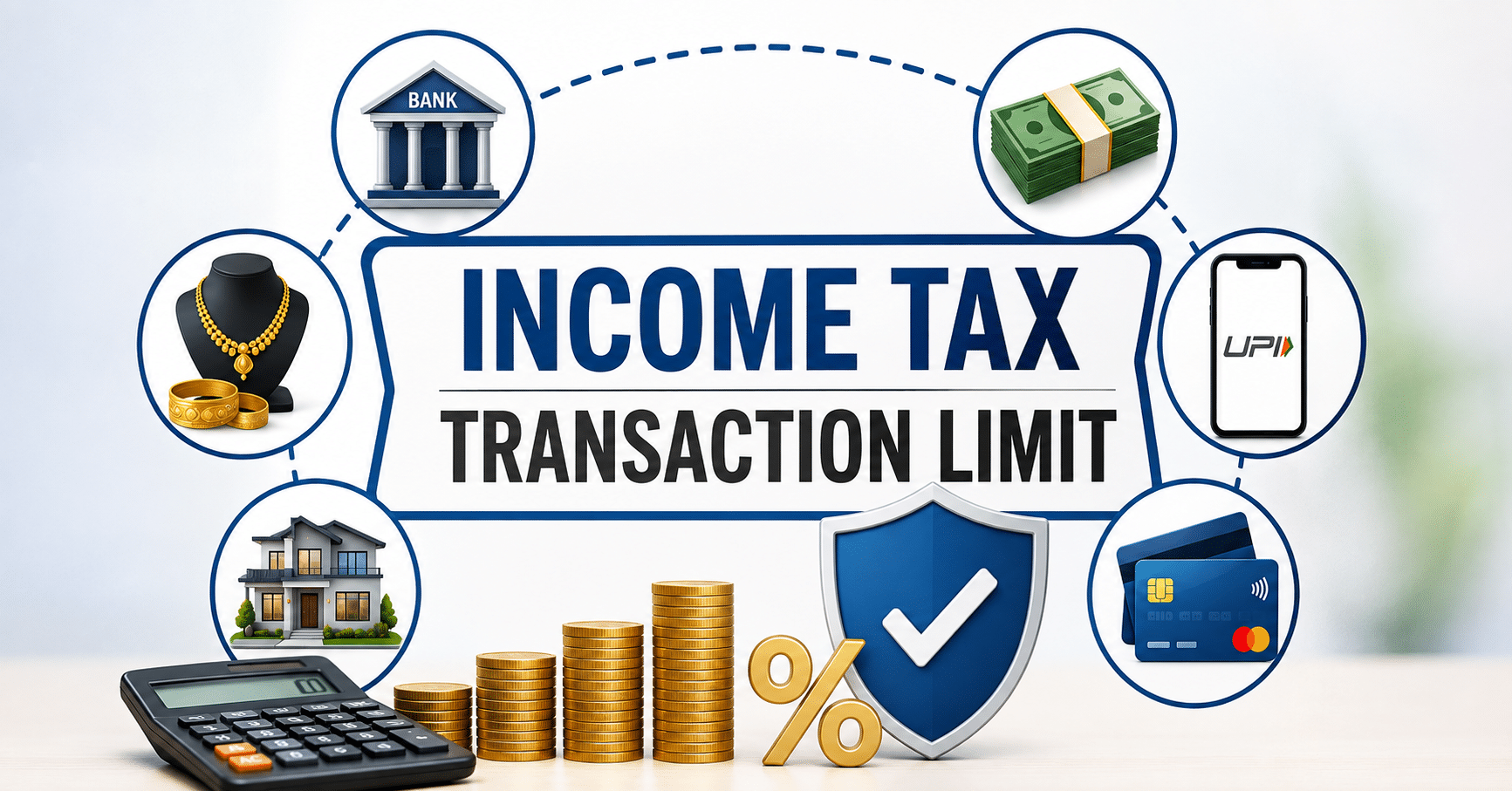
ToggleNew Income Tax Transaction Limit 2026: Bank, Cash, UPI, Gold, Property & Credit Card Transaction Limits
Wondering about the new income tax transaction limits for FY 2026-27? Can you deposit ₹10 lakh cash into your bank account? How much cash can you use for a property deal? Is there a limit on the amount of gold you can keep at home? And what happens if your credit card payments cross a certain amount?
With several tax and financial rules changing or being updated for FY 2026-27 under the new income tax transaction limits, taxpayers need to understand the difference between transaction limits, reporting thresholds and tax implications.
In this guide, CharteredHelp explains the important limits and reporting rules related to cash transactions, bank accounts, UPI payments, gold holdings, property transactions and credit card payments in simple language.
Important: A transaction being reported to the Income Tax Department does not automatically mean that it is illegal or taxable. Reporting thresholds and legal transaction limits are different concepts.
What Are the New Income Tax Transaction Limits in 2026?
Before discussing the new income tax transaction limits for bank transactions, cash payments, UPI, gold, property, and credit cards, it is important to understand that a transaction limit, a reporting threshold, and a tax liability are not the same thing.
What Is a Transaction Limit?
Under the new income tax transaction limits, a transaction limit is the maximum amount or threshold prescribed under a particular law or applicable rule for a specific type of transaction. In some cases, transactions above a certain amount may be restricted, especially when they are made in cash.
However, the applicable limit can vary depending on the type of transaction, payment method, account, and relevant tax or financial regulations.
What Is a Reporting Threshold?
As part of the new income tax transaction limits, a reporting threshold is an amount above which a bank, financial institution, or other reporting entity may be required to report a transaction to the Income Tax Department under the applicable Statement of Financial Transactions (SFT) rules.
For example, certain high-value bank transactions or credit card payments may be reported to the tax authorities once they cross the prescribed threshold.
Important: A transaction being reported does not mean that the transaction is illegal or that you automatically have to pay tax on that amount.
What Is a Cash Transaction Restriction?
Certain provisions of the Income Tax Act, forming part of the new income tax transaction limits, restrict accepting or making cash payments above specified amounts for particular types of transactions.
These restrictions are different from reporting requirements. In some situations, making or accepting cash above the prescribed limit can result in a penalty, even if the source of the money is legitimate.
Therefore, taxpayers should understand the applicable cash restrictions before making high-value cash transactions.
What Does Reporting in AIS or SFT Mean?
Under the new income tax transaction limits framework, AIS (Annual Information Statement) contains financial information reported to the Income Tax Department by various reporting entities. SFT is one of the mechanisms through which specified high-value financial transactions are reported.
If a transaction appears in your AIS, it generally means that information about that transaction has been reported to the tax department. You should check whether the information is accurate and whether it is properly reflected in your Income Tax Return, wherever applicable.
Reported Transaction ≠ Tax Liability
One of the most important things to understand is:
A reported transaction does not automatically become taxable income.
For example, if you make a high-value purchase using money from your disclosed income or a legitimate loan, the transaction may be reported, but the reported amount itself is not necessarily your taxable income.
The Income Tax Department may, however, seek clarification if a transaction appears inconsistent with your reported income or if the source of funds cannot be satisfactorily explained.
In short, always distinguish between a transaction limit, a reporting threshold, a cash restriction, and actual taxability. This distinction will help you understand the rules discussed in the sections below.
Bank Transaction Limits and Cash Deposit Rules
| Transaction | Relevant Limit/Rule | What Happens? |
|---|---|---|
| Savings account cash deposit | Applicable reporting threshold | High-value transactions may be reported |
| Current account cash transactions | Applicable reporting threshold | SFT/reporting may apply |
| Cash withdrawal | Applicable rules | May be subject to reporting/other provisions |
| Online bank transfer | Depends on banking channel | Bank-specific operational limits may apply |
| Multiple bank accounts | No general Income Tax limit on number of accounts | Disclosure requirements may apply |
Is There a Limit on How Much Money You Can Keep in a Bank Account?
Income Tax law generally does not prescribe a simple maximum balance that every individual can maintain in a bank account. However, large or unusual transactions can attract reporting and scrutiny, particularly where the source of funds is unclear.
Cash Transaction Limits in India
Cash transactions are subject to several restrictions under Indian income-tax law. These rules are designed to discourage large cash dealings and encourage transactions through traceable banking channels.
However, it is important to understand that there is no single cash transaction limit that applies to every situation. The applicable restriction depends on the nature of the transaction, such as receiving cash, giving a loan, repaying a loan, purchasing property, making business payments, or making donations.
Cash Receipt Restrictions
Under Section 269ST, a person generally cannot receive ₹2 lakh or more in cash:
- From a person in a day;
- In respect of a single transaction; or
- In respect of transactions relating to one event or occasion.
The restriction can apply even when the total amount is split into multiple cash payments. Therefore, dividing a large cash transaction into smaller payments does not necessarily avoid the restriction.
Violation of Section 269ST can attract a penalty equal to the amount received in contravention of the provision.
Cash Loan, Deposit and Repayment Restrictions
Cash restrictions also apply to certain loans, deposits and their repayments.
Under Section 269SS, accepting a loan or deposit of ₹20,000 or more in cash is generally restricted, subject to the exceptions provided under the law.
Similarly, Section 269T restricts repayment of certain loans or deposits of ₹20,000 or more through cash, subject to specified exceptions.
For example, if you need to borrow a significant amount from another person, using a proper banking channel such as account-payee cheque, bank transfer or another permitted electronic mode is generally safer than accepting the amount in cash.
Important: These provisions have specific exceptions, so the nature of the parties and transaction should be considered before applying the ₹20,000 threshold.
Cash Payment for Property Transactions
Property transactions require particular caution when it comes to cash.
Cash payments connected with the purchase or sale of property can be subject to restrictions under the Income Tax Act. For example, certain advances or specified sums relating to the transfer of immovable property are covered by provisions restricting cash transactions above ₹20,000.
Therefore, buyers and sellers should avoid using large amounts of cash for property deals and maintain proper documentation of the payment.
A safer approach is to use bank transfers, account-payee instruments or other traceable payment methods and retain the relevant agreement, receipt and payment records.
Cash Donations
Cash donations also have tax-related restrictions.
If you want to claim a deduction for a donation, the amount and mode of payment become important. Under the applicable provisions, cash donations exceeding ₹2,000 are generally not eligible for deduction under Section 80G.
Therefore, if you are making a donation and want to claim the eligible tax deduction, it is advisable to make the payment through a traceable non-cash mode and keep the donation receipt.
Cash Business Expenses
Businesses also need to be careful when making payments in cash.
Under Section 40A(3), certain business or professional expenditure exceeding ₹10,000 in a day paid otherwise than through the prescribed banking/electronic modes may be disallowed while calculating taxable business income. A higher threshold of ₹35,000 applies in specified cases involving payments to transporters.
There are exceptions under the Income Tax Rules, so the provision should not be applied mechanically to every cash payment.
For businesses, maintaining proper invoices and using banking or prescribed electronic payment methods can help avoid unnecessary tax complications.
Do Not Confuse Cash Transaction Limits With Cash Reporting Limits
One of the most common misconceptions is that every transaction above a particular amount is illegal or taxable.
That is not correct.
A cash transaction restriction tells you when a particular cash transaction is prohibited or can attract a penalty.
A reporting threshold, on the other hand, determines when a bank, financial institution or other reporting entity may have to report certain transactions to the Income Tax Department under the Statement of Financial Transactions (SFT) framework.
Therefore:
Cash transaction limit ≠ Cash reporting limit ≠ Tax liability
A transaction being reported to the Income Tax Department does not automatically mean that the amount is taxable or that you have violated the law. What matters is the nature of the transaction, its source, the applicable provision and whether it has been correctly disclosed.
UPI Transaction Limit in 2026
UPI has become one of the most widely used payment methods in India. However, there is an important distinction that taxpayers should understand:
UPI transaction limits are not the same as Income Tax transaction limits.
UPI limits are primarily governed by the applicable NPCI framework, participating banks and the transaction category. Banks may also prescribe their own internal limits within the applicable overall framework.
What Is the Normal UPI Transaction Limit?
There is no single UPI limit that applies identically to every transaction.
For person-to-person (P2P) transactions, the applicable limit continues under the existing UPI framework, while banks and participating institutions may apply their own operational limits.
For certain verified merchant categories, NPCI has permitted higher per-transaction limits. For example, the limit for certain tax-payment-related merchant categories has been enhanced to ₹5 lakh per transaction, subject to the applicable conditions.
Therefore, you should not assume that every UPI user can simply transfer ₹5 lakh in every type of transaction.
Are UPI Limits the Same for Every Bank?
No.
The actual amount you can transfer through UPI may depend on:
- Your bank’s internal limit
- The UPI app you are using
- Whether the transaction is P2P or merchant-based
- The category of the merchant
- NPCI’s applicable limit for that category
- Your bank’s security and risk-management policies
NPCI specifically allows member banks to maintain internal limits within the overall ceilings prescribed by the UPI framework.
So, if your bank allows you to send a lower amount than the maximum permitted under the broader UPI framework, that does not necessarily indicate a problem.
Are There Higher UPI Limits for Certain Categories?
Yes.
NPCI has introduced higher per-transaction limits for selected categories, particularly certain verified merchant transactions. These include categories where higher-value digital payments may be required.
The applicable limit can therefore be higher than the commonly understood ₹1 lakh figure for certain merchant transactions. However, the higher limit is category-specific and does not mean that the standard P2P UPI limit has been increased to the same amount.
Is UPI Payment Taxable?
No, making a UPI payment does not by itself create a tax liability.
UPI is simply a payment method.
For example, if you use UPI to pay ₹1 lakh for a product or service, the payment itself is not treated as ₹1 lakh of taxable income.
However, the underlying transaction may have tax implications depending on what the payment represents.
Similarly, receiving money through UPI does not automatically mean that the amount is taxable income. Its tax treatment depends on whether it is business income, a gift, a loan, reimbursement, transfer of your own funds, or another type of receipt.
Can Large UPI Transactions Trigger Income Tax Scrutiny?
A large UPI transaction is not automatically illegal or taxable simply because it is large.
However, financial transactions may be examined where they appear inconsistent with a taxpayer’s disclosed income, financial profile or other information available with the tax authorities.
The key point is:
The mode of payment does not determine taxability. The nature and source of the transaction matter.
For high-value transactions, it is therefore advisable to maintain supporting documents such as invoices, agreements, bank statements, loan documents, receipts or other relevant proof.
How Much Gold Can You Keep at Home?
“How much gold can an individual legally keep at home?” is one of the most misunderstood questions related to Income Tax.
Gold Jewellery Holding Guidelines
| Individual | Commonly referred benchmark |
|---|---|
| Married woman | 500 grams |
| Unmarried woman | 250 grams |
| Man | 100 grams |
These are CBDT search-related guidelines/instructions regarding jewellery that may generally not be seized when the source is satisfactorily explained—not a simple law saying that possessing more gold automatically makes it illegal.
What If You Have More Gold Than These Amounts?
Explain:
- Purchase invoice
- Inheritance
- Gifts
- Family wealth
- Source of acquisition
- Income/wealth records
Is Gold Received as a Wedding Gift Taxable?
Explain gift-tax provisions and relationship/exemption rules carefully.
Property Transaction Cash Limits
This can be one of the strongest sections.
| Property-related transaction | Cash restriction |
|---|---|
| Advance/bayana | Applicable cash restriction |
| Security deposit | Applicable cash restriction |
| Repayment/refund | Applicable cash restriction |
| Sale consideration | Applicable provisions |
Does Credit Card Reporting Mean You Will Receive an Income Tax Notice?
Not necessarily. Reporting of a transaction does not automatically mean that an income tax notice will be issued. The department may compare reported transactions with the taxpayer’s income, return and other financial information.
How AIS Reports Your High-Value Transactions
AIS = Annual Information Statement
Mention that AIS can contain information relating to:
- Bank transactions
- Interest
- Securities
- Mutual funds
- Property transactions
- Credit card payments
- TDS/TCS
- Other reported financial transactions
Then:
What Should You Do If AIS Shows a Transaction?
- Check the transaction.
- Compare it with your records.
- Verify whether the information is correct.
- Submit feedback if necessary.
- Keep supporting documents.
Does a High-Value Transaction Automatically Mean Income Tax?
No.
This should be a prominent section.
Example:
Suppose you purchase a property worth ₹50 lakh using money accumulated from your disclosed income and a documented home loan. The transaction may be reported to the tax authorities, but the mere fact that it is high-value does not mean the entire amount is taxable income.
This is a very useful educational point.
Income Tax Transaction Limits 2026 – Quick Summary
| Transaction | What You Should Know |
|---|---|
| Bank cash deposit | Reporting thresholds may apply |
| Cash withdrawal | Applicable reporting provisions may apply |
| UPI | Limits depend on transaction type/bank |
| Gold | Holding guidelines should not be confused with a statutory ownership cap |
| Property cash transactions | Strict cash restrictions apply |
| Credit card payments | Certain high-value transactions can be reported |
| Bank accounts | No general maximum number of accounts |
| AIS | Reported transactions can be viewed and verified |
How to Stay Safe From Income Tax Scrutiny
Follow these 7 practices:
- Keep bank statements.
- Preserve property agreements.
- Keep gold purchase invoices.
- Maintain proof for gifts/inheritance.
- Avoid unnecessary cash transactions.
- Check your AIS regularly.
- Make sure your ITR reflects your actual income and major transactions.
Frequently Asked Questions
There is no single cash transaction limit applicable to every type of transaction in India. Different provisions of the Income Tax Act apply depending on the nature of the transaction.
For example, Section 269ST generally restricts receiving ₹2 lakh or more in cash from a person in a day, for a single transaction, or for transactions relating to a single event or occasion. Separate restrictions apply to cash loans, deposits, repayments, property-related transactions and certain business expenses.
Therefore, the applicable cash limit should always be checked based on the specific transaction.
There is no simple universal maximum amount of cash that an individual can deposit into a bank account. However, large cash deposits can be reported by banks under the applicable Statement of Financial Transactions (SFT) reporting requirements.
For example, certain high-value cash deposits in savings-type accounts are reportable once the prescribed annual threshold is crossed.
A reported transaction does not automatically mean that the money is taxable. However, you should be able to explain and substantiate the source of the cash, particularly when the amount is significant.
Generally, the Income Tax Department does not prescribe a fixed maximum number of bank accounts that an individual can maintain.
However, taxpayers should maintain proper records of their accounts and ensure that their income, interest and other relevant financial information is correctly reported in the Income Tax Return wherever required.
The important issue is not the number of bank accounts, but whether the transactions and income associated with those accounts are properly accounted for and explained.
There is no single UPI transaction limit applicable to every type of payment. The applicable limit can depend on the transaction category, bank, UPI service provider and NPCI framework.
The standard limit for many person-to-person transactions differs from the higher limits permitted for certain eligible merchant categories. For selected categories, NPCI has permitted higher per-transaction limits.
Therefore, you should check the applicable limit with your bank or UPI service provider rather than assuming that the same limit applies to every UPI transaction.
Also remember: UPI limits are payment-system limits and should not be confused with Income Tax reporting or taxability rules.
The commonly cited CBDT search guidelines provide benchmarks of 500 grams for a married woman and 250 grams for an unmarried woman, while 100 grams is commonly cited for a male member.
However, these figures should not be treated as a general statutory maximum on gold ownership. They relate to circumstances in which jewellery may generally not be seized during an income-tax search, subject to the facts and circumstances.
If you own gold beyond these commonly cited quantities, it does not automatically mean that the gold is illegal. You should, however, be able to establish its legitimate source, such as purchase, inheritance or gifts, with appropriate documentation wherever possible.
Gold received as a wedding gift can be exempt from tax under the gift provisions when it qualifies as a gift received on the occasion of marriage.
However, the tax treatment can depend on the nature and circumstances of the gift. It is advisable to maintain supporting evidence such as purchase records, gift documentation or other available proof, particularly for high-value jewellery.
Also remember that the tax treatment of a wedding gift is different from gifts received on ordinary occasions, where separate gift-tax rules may apply.
Cash payments and receipts relating to property transactions are subject to specific restrictions under the Income Tax Act.
In particular, certain amounts received as an advance or specified sum in connection with the transfer of immovable property are subject to a ₹20,000 cash restriction under the applicable provisions.
Therefore, buyers and sellers should generally use traceable banking channels for property payments and maintain agreements, receipts and proof of payment.
A property transaction should not be structured by simply splitting a large cash payment into smaller amounts to avoid the applicable restriction.
Yes. Certain high-value credit card transactions and payments can be reported to the Income Tax Department under the applicable SFT reporting framework.
The reporting of a credit card transaction does not automatically mean that the amount is taxable or that you will receive an income-tax notice. The department can compare reported transactions with information such as your income, tax return and other financial records.
If a high-value credit card transaction is legitimate, you should maintain proper records showing the source of funds and nature of the expenditure.
No. A high-value transaction does not automatically mean that you will receive an Income Tax notice.
However, transactions reported to the tax authorities may be compared with the information available in your Income Tax Return and other financial records.
If a transaction appears inconsistent with your reported income or its source cannot be satisfactorily explained, the department may seek clarification.
Therefore, the safest approach is to maintain proper documentation and accurately report your income and applicable transactions.
AIS stands for Annual Information Statement. It provides taxpayers with a comprehensive view of information available with the Income Tax Department, including information relating to TDS/TCS, SFT transactions, taxes paid and certain other financial information.
To check your AIS:
- Visit the Income Tax e-Filing portal.
- Log in using your credentials.
- Go to e-File → Income Tax Return → View AIS.
- Click Proceed to access the AIS portal.
- Select the relevant information and review your reported transactions.
CharteredHelp Tip: Check your AIS before filing your ITR so that you can identify discrepancies in reported financial information and take appropriate action in time.
If you find incorrect information, AIS also provides a facility to submit feedback on eligible reported information.

CharteredHelp is a team of experienced professionals providing tax, accounting, auditing, and compliance services for businesses and individuals. With over 10+ years of experience, we assist clients with GST registration and filings, income tax returns, company registration, trademark services, accounting, auditing, and handling tax notices. Our focus is on providing practical, reliable, and timely support to help clients stay compliant and grow their businesses with confidence.